
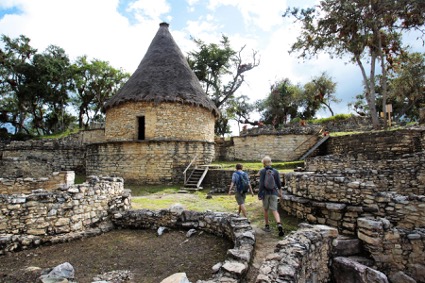
In mid-May, a funerary structure containing skeletal remains of five individuals and ceremonial objects was discovered at the Kuelap Archaeological Complex in Amazonas region.
It is the first structure of its kind to be found, shedding light on the high cultural development achieved by the Chachapoya civilization during the Late Intermediate Period.
Andina News Agency spoke with Rocio Sanchez, Chief of the Decentralized Directorate of Culture (DDC) in Amazonas.
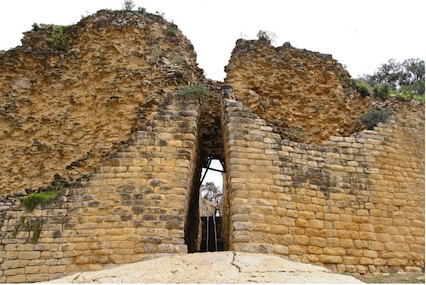
She revealed details of this significant archaeological discovery—including the remains of five individuals, a phytomorphic paccha in the Inca style, Spondylus fragments, and carved figures in Area 12—whose location within the Kuelap monument, at the junction of its two main access routes, underscores its importance.
The funerary structure was discovered by archaeologists from the Kuelap Archaeological and Interdisciplinary Research Program (PRIAK).
They conducted their work in Area 12, at the junction of Kuelap’s Accesses 1 and 2, a strategic sector of the so-called “Pueblo Bajo” (Lower Town) that had never previously been the subject of systematic studies.
A sacred place in plain sight
The DDC head told Andina News Agency that the discovery’s significance lies not only in the objects unearthed, but also in the precise location where they were found.
“The importance of this discovery lies in the area where it is located. It is in the lower section, in the Lower Town, in the central part, at the junction of Kuelap’s two most important entrances,” she noted.
According to Sanchez, one of those access routes is located to the west and the other to the east, and they had never previously been studied together.
“The discovery of this funerary context indicates that this location was, in some way, very important and sacred to them, and it was in plain sight of everyone,” she stated.
The funerary structure is made of stone and features a horseshoe-shaped—or U-shaped—layout, built on a platform that is accessed by climbing two steps.
Its design made it visible from both access routes to the complex, reinforcing its likely ceremonial function and public role within Kuelap’s spatial organization.
Five Individuals and a possible second phase of use
Inside the structure, archaeologists recovered the skeletal remains of five individuals: four adults and one infant.
One of them was found in a seated position, deposited above the other remains, which has given rise to a preliminary hypothesis regarding a second period of use of the same funerary structure.
“What has proven particularly interesting is the position of one individual, who was placed in a seated position and deposited above other skeletal remains, which could indicate a second period of use of this funerary structure,” Sanchez explained.
The director added that the skeletal remains found within the structure show signs of disturbance, which would confirm that it was not a single burial event.
The structure functioned as a kind of seat visible from the outside.
“That seat where this material was placed was on the exterior, it was visible, and anyone entering either from the west or from the east could see it,” the official detailed.
“That indicates it was an important place, an interesting place, a place where homage was perhaps paid,” she said.
Offerings: An Inca paccha, spondylus, and carved figures
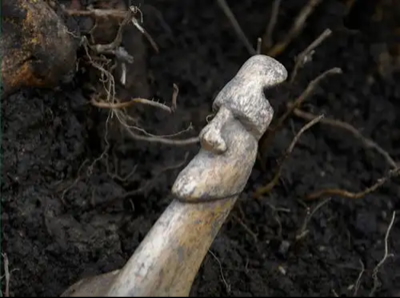
Among the objects recovered from the funerary context were a complete phytomorphic paccha in the Regional Inca style depicting the pacay fruit, found intact, as well as Spondylus fragments and carved figures.